WHAT IS CONSTRUCTED AND WHAT IS ACTION:
INVESTIGATING CONSTRUAL IN BODILY ACTION DEPICTIONS
Wink
A DISSERTATION
Submitted to the Department of Linguistics and the Graduate School of Gallaudet University in partial fulfillment of the requirements for the degree of Doctor of Philosophy
April, 2025
Copyright © 2025 Wink
All rights reserved
ACKNOWLEDGMENTS
ABSTRACT
Constructed Action (CA) is a widely noted form of depiction in signed languages, yet its theoretical characterization remains elusive. Introduced as parallel to Tannen’s (1986) Constructed Dialogue, the term underscores that depicted bodily actions are actively constructed rather than merely replicated. However, the defining property of constructed-ness has been underdescribed, with existing accounts presenting CA as little more than depictions of real or imagined actions that may to some degree diverge from verbatim-like reproduction. Moreover, the notion of CA appears to have a general definition that allows not just constructed dialogue, but also classifier constructions to be subsumed under that term.
This dissertation approaches the terms constructed and action in CA from the perspective of Cognitive Grammar (CG) (Langacker 2008), arguing that CA is best analyzed in terms of conceptual structure—that is, the content being described and the construal imposed on that content. From this vantage point, CA consists of a conception of a body, an action, and the construing of that bodily action, where signers impose varying levels of schematicity, modulate the scope of the bodily depiction and the window of attention onto the action, and engage imaginative processes. The framework of construal thus accounts for the inherent subjectivity of CA, aligning with Tannen’s argument that discourse constructions reflect the choices of the speaker, or in CG terms, the conceptualizer, rather than just the objective situation being described. Additionally, Tannen’s descriptions of constructed dialogue types are viewed here as involving various types of construal operations that produce a conceptual structure. In redefining CA as a conceptual event rather than a direct depiction of a bodily action, this dissertation argues that the typology proposed by Cormier et al. (2015)—overt, reduced, and subtle CA—is just one of several dimensions of construal: scope-of-body. As such, their annotation scheme captures only a limited facet of the conceptual operations at play in CA.
By situating CA within a CG framework, this dissertation advances a meaning-based account of depiction, which emphasizes the active role of signers in construing bodily action rather than merely reproducing it. This approach provides a more principled means of distinguishing bodily action depictions from other forms of representation while contributing to broader discussions on conceptualization, embodiment, and linguistic representation.
Table of contents
(Links below will jump to desired section)
Chapter I: What is "Constructed" and What is "Action"?
1.1 The problem with “constructed”
1.2 The problem with “action”
1.3 Data collection
1.4 Dissertation structure
1.5 Chapter conclusion
Chapter II: Foundational Concepts
2.1 Depiction
Depiction: intentional projections of the mind
Performed depictions
Decisions impacting the proximal scene
2.2 Constructed Action
Shifting to show an action or dialogue
Constructed, not reported
2.3 Types of constructed action
Direct action - simultaneous direct and indirect action - indirect constructed action
Overt - reduced - subtle constructed action
Liddell & Metzger (1998)
2.4 The cognitive linguistics approach
Conceptualization as opposed to objective content
The same situation described in two different ways
2.5 Conceptualization
Conceptual content
Construal dimensions
Specificity
Focusing
Scope
Perspective
Imagination
2.6 Selected cognitive linguistic applications to sign language
Analogue building model of linguistic iconicity
Real space blends
Agent defocusing
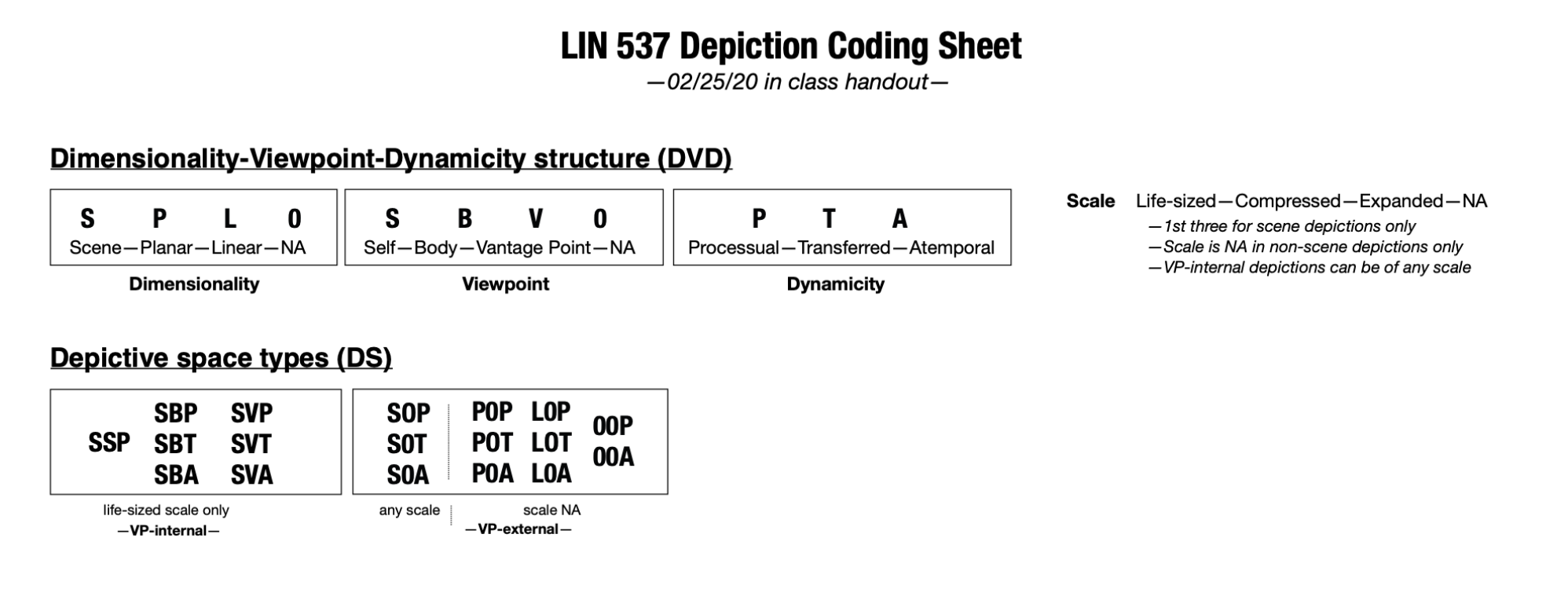
2.7 Depiction analysis framework
2.8 Methods in this dissertation
2.9 Chapter conclusion
Chapter III: Conceptual Content of Constructed Actions
3.1 Content and roles in conceptualizations of bodily experience
Conceptual content in bodily action
Semantic roles in scenes
3.2 Semantic roles of self, action, and body
Body action SBP and SSP
Involuntary bodily action
Body as zero and vantage point the absence of constructed action
3.3 Constructed action as one type of bodily experience depiction
Foregrounding and backgrounding kinesthetic content
Foregrounding dialogue
Liddell & Metzger (1998)
3.4 Chapter conclusion
Chapter IV: Imposing Construal
4.1 Imposing construal of specificity
Schematic and specified bodily action
Schematic and specified body
4.2 Imposing construal of scope
Scope of bodily action
Scope of body
4.3 Imposing construal of perspective
4.4 Imposing construal of imagination
Imaginative vantage points
Metaphor
Abstraction
4.5 Rethinking “types” and “categories” as different construals
Rethinking Cormier et al’s types as imposing scope
Rethinking Metzger construction categories as imposing construals
4.6 Chapter conclusion
Chapter V: Conclusion
5.1 Dissertation summary
5.2 Research assumptions and interpretations
5.3 Future directions
5.4 Conclusion
LIST OF TABLES
Table 1.1 Edited Data Totals
Table 2.1 Reproduction of Tannen (1989) and Metzger (1995) construction categories
Table 2.2 Liddell & Metzger's (1998) CA types
Table 3.1 Liddell & Metzger's (1998) CA types and their corresponding DVD Structures
LIST OF FIGURES
Figure 2.1 Model of the USS Arizona. Pearl Harbor, Hawaii. (2019) Personal Collection
Figure 2.2 Tactile bronze display of the USS Arizona
Figure 2.3 Patsy Ann Statue, Juneau, Alaska. (2017) Personal Collection
Figure 2.4 Aligning notions of CA: Liddell & Metzger (1998), Cormier at al. (2015)
Figure 2.5 Utterance with unspecified agent. Reproduced from Rankin (2013)
Figure 3.1 Two internal viewpoint depiction structures for CA
Figure 3.2 Aligning notions of CA: Liddell & Metzger (1998), Cormier at al. (2015)